The Wildcats Story

The Wildcats Story

The Wildcats Story
'Inspiring and entertaining West Australians for four decades'
The Wildcats are Born
The National Basketball League began in 1979 as a 10-team competition, made up of franchises from Victoria, New South Wales, Queensland, South Australia and the ACT.
After three years of lobbying by the Gordon Ellis led Perth basketball community, a side from Western Australia was granted entry to the NBL and, as such, the state’s longest-running national sporting club was born.
The Westate Wildcats, as they were then known, played its first-ever game at the 800-seat Perry Lakes Stadium on 5 February 1982.
Mike Ellis was the inaugural captain and Henry Daigle the head coach.
Basketball popularity grew in the West and in 1984 for the team was renamed the Perth Wildcats, launching the iconic brand we know today.
However, the team struggled in its first five years, failing to make the Finals despite three changes to the head coach role.
The Finals Streak Begins
1987 was the start of something special for the Perth Wildcats. Firstly, it moved to the Perth Superdrome (now HBF Stadium), increasing its home game capacity by over six-times.
NBL star of eight years Cal Bruton took over as player-coach, and the team added now iconic names James Crawford, Alan Black and Trevor Torrance to a roster still led by captain Mike Ellis.
The changes had an immediate impact with the Wildcats not only making their first Finals series, but playing in its first Grand Final – which it lost to the Brisbane Bullets.
Regardless, it was a stunning turnaround for the team that finished in 12th place just 12 months earlier.
1987 marks year-one of the Wildcats incredible, unbeaten consecutive NBL Finals streak.
The Golden Era
Three years later, a new decade brought more rapid growth and exciting change to the popular Perth team.
Media mogul Kerry Stokes took ownership of the franchise and moved it to the 8,000-seat Perth Entertainment Centre in the city’s CBD.
Now retired as a player, Cal Bruton recruited 23-year-old point guard from the University of Oklahoma – Ricky Grace.
After finishing the 1990 regular season with a 17-9 record, the Wildcats earned their way back to the Grand Final where it would once take on the Brisbane Bullets.
The series went to a deciding third game, but the Wildcats were too good, winning 109-86 on Brisbane to bring the NBL Championship Trophy to WA for the first time.
Grace was named Grand Final MVP.
Just a few months later, the Wildcats strengthened its squad with the addition of another future Australian basketball legend – Andrew Vlahov.
The 22-year-old West Australian had returned from Standford University and in his rookie season became a champion under coach Murray Arnold.
The Perth Wildcats had gone back-to-back for the first time – and this time they lifted the trophy in front of their home crowd.
1993 saw Vlahov begin his tenure as captain of the club as Mike Ellis historic career came to an end, while Adrian Hurley became the Wildcats eighth head coach.
Two-time NBL MVP Scott Fisher was now also in Wildcats colours, while sharp-shooter Anthony Fisher and young gun Martin Cattalini were added to the squad which, in 1995, claimed both the pre-season title, minor premiership and the championship.
In 1998, the NBL made the switch from a winter to a summer competition, and a season later, the Perth Wildcats would undergo a change of their own with three-time NBA Champion Luc Longley and Andrew Vlahov taking over ownership of the club.
Once again, the new-look would lead to immediate success with Perth taking out the 2000 title with the addition of Paul Rogers and Marcus Timmons to a core which still contained Vlahov, Grace and Fisher.
Alan Black became a championship coach after losing the position a decade earlier, whole Rogers became the first Wildcat to be named NBL MVP.
Championship Drought
To put the term “drought” into perspective, the Perth Wildcats never missed a Finals series in the 2000s and even played in a Grand Final in 2003 but, for Wildcats fans, nine years without a title is a long time.
The decade saw the retirements of Andrew Vlahov and in 2002, Scott Fisher in 2003 and Ricky Grace in 2005, closing the book on the storied 90s Wildcats team.
With the closure of the Perth Entertainment Centre, the Wildcats once again played its home games at the smaller Perth Superdrome from the 2002/03 season, meaning it’s capacity decreased by 3,000 fans and visibility was substantially reduced with the move away from the CBD.
The head coach position was held by Mike Ellis, Scott Fisher and Conner Henry and, on the court, the team was led by Tony Ronaldson and Paul Rogers following Grace’s retirement.
The decade did see the rise of a new Wildcats legend in Shawn Redhage, who joined the team in 2005 and would go on to claim six club MVP awards, win four titles and become the club’s second most-capped player.
In 2007, businessman and philanthropist Dr Jack Bendat took ownership of the club, with a new focus on community engagement.
Dr Bendat’s vision was to use the profile of players to help improve literacy and numeracy while reducing truancy in school students, particularly in lower socio-economic suburbs.
The change of ownership was a major turning point for the organisaiton, with Dr Bendat still the Perth Wildcats Chairman today.
The Rapid Rebuild
Under new management and with new coach Rob Beveridge at the helm, the Perth Wildcats underwent a rapid rebuild, the core of which would see them through the next decade.
Redhage was retained alongside Brad Robbins, while future household names Damian Martin, Jesse Wagstaff and Kevin Lisch played their first seasons in red.
Martin was Beveridge’s captain at Australia’s Gold Medal winning 2003 Under-19 World Championship Team, while Wagstaff and Lisch were rookies fresh out of the US college system.
The new look paid off immediately, as the Wildcats returned to the top of the NBL, claiming it’s fifth title – ending a decade-long drought.
In the following three years the New Zealand Breakers emerged as Perth’s biggest rivals, with the two teams facing off in the 2012 and 2013 NBL Grand Finals.
While Lisch became the second Wildcat to be named NBL MVP in 2012, the Kiwis were too good, and another change was needed for the Wildcats to climb back to the top of the mountain.
The Perth Arena Era of Dominance
The catalyst for the Perth Wildcats returning to prominence in the West Australian cultural landscape was its move to the brand new Perth Arena in the heart of the Perth CBD.
It held over 13 thousand fans and, all of a sudden, the Wildcats presence was back to where it was in the 90s.
To fill the venue, the organisation had to increase its membership by two to three times – a remarkable accomplishment it pulled off, with Perth city streets turning red with fans on game nights.
Basketball was back in the city.
Following the Grand Final loss to New Zealand in the first year at the venue, Beveridge and Lisch departed, replaced by new coach Trevor Gleeson and rookie James Ennis – a Miami Heat draftee looking to spend a year abroad before commencing a career in the NBA.
Ennis’ influence was a turning point for the entire NBL, with his highlight-filled performances filling the Arena and dropping jaws around the country.
The game had changed, and the expectation of NBL imports had increased significantly.
Ennis, alongside Jermaine Beal, Greg Hire, Matt Knight as well as Martin, Wagstaff and Redhage would see Gleeson become a championship-winning coach in his first season at his new home.
It’s fair to say in the years that followed, the Perth Wildcats dominated the competition.
It returned to its championship-winning ways in 2016, before going back-to-back for the first time since 1991 in 2017.
After a semi-final exit in 2018, the benchmark-franchise went back-to-back again in 2019 and 2020.
Casey Prather was the team’s star from 2015 to 2017, before Bryce Cotton made a case as the club’s best ever player from 2017 to 2020.
In a three-and-a-half-year stretch, Cotton won three titles, two Grand Final MVP awards, and became the first Wildcat to be named NBL MVP twice in 2018 and 2020.
Damian Martin became a club legend, winning six NBL Best Defensive Player awards as the face and on-court leader of the organisation in the 2010s, while he and Jesse Wagstaff made history by becoming the only players to win six-championships at the one team.
As the star-studded roster aged, the club brought in Australian Boomer talent Nick Kay, Mitch Norton and Clint Steindl to carry the club into another era of success.
Trevor Gleeson went from the club’s only dual title-winning coach, to a five-time champion all in eight seasons at the helm.
SEN Era Begins
At the conclusion of the 2021 NBL Season, Sports Entertainment Network acquired 100 per cent of the Perth Wildcats from Dr Bendat.
Adding to the changes, Trevor Gleeson departed the Wildcats after joining the Toronto Raptors as an assistant coach.
The new ownership era was then kickstarted by the appointment of Boston Celtics assistant coach Scott Morrison as the new Perth Wildcats new head coach, and Philadelphia 76ers head of scouting Danny Mills signed as the club's first general manager of basketball operations.
Former Adelaide 36ers sharpshooter John Rillie took over from Morrison as head coach for the 2022-23 season, with the Wildcats making the play-in tournament.
After an off-season of change, which included the recruiting of Next Star Alex Sarr, big man Keanu Pinder from Cairns Taipans, imports Kristian Doolittle, Jordan Usher and tough New Zealander Hyrum Harris, the Wildcats returned to play-offs action in 2023-24.
Finishing second after the home-and-away season, the Wildcats lost their see-sawing semi-final series to eventual champions Tasmania 2-1.
Bryce Cotton won his third Andrew Gaze Trophy as the competition's Most Valuable Player to go with a record-equalling sixth Gordon Ellis Medal as the Wildcats' MVP.
French teen Sarr's stunning debut season in the NBL saw him snapped up by Washington with pick No.2 in the 2024 NBA Draft.
General Enquiries
Have a question, comment, or just want to say hi? Fill out the form and we’ll get back to you as soon as we can.
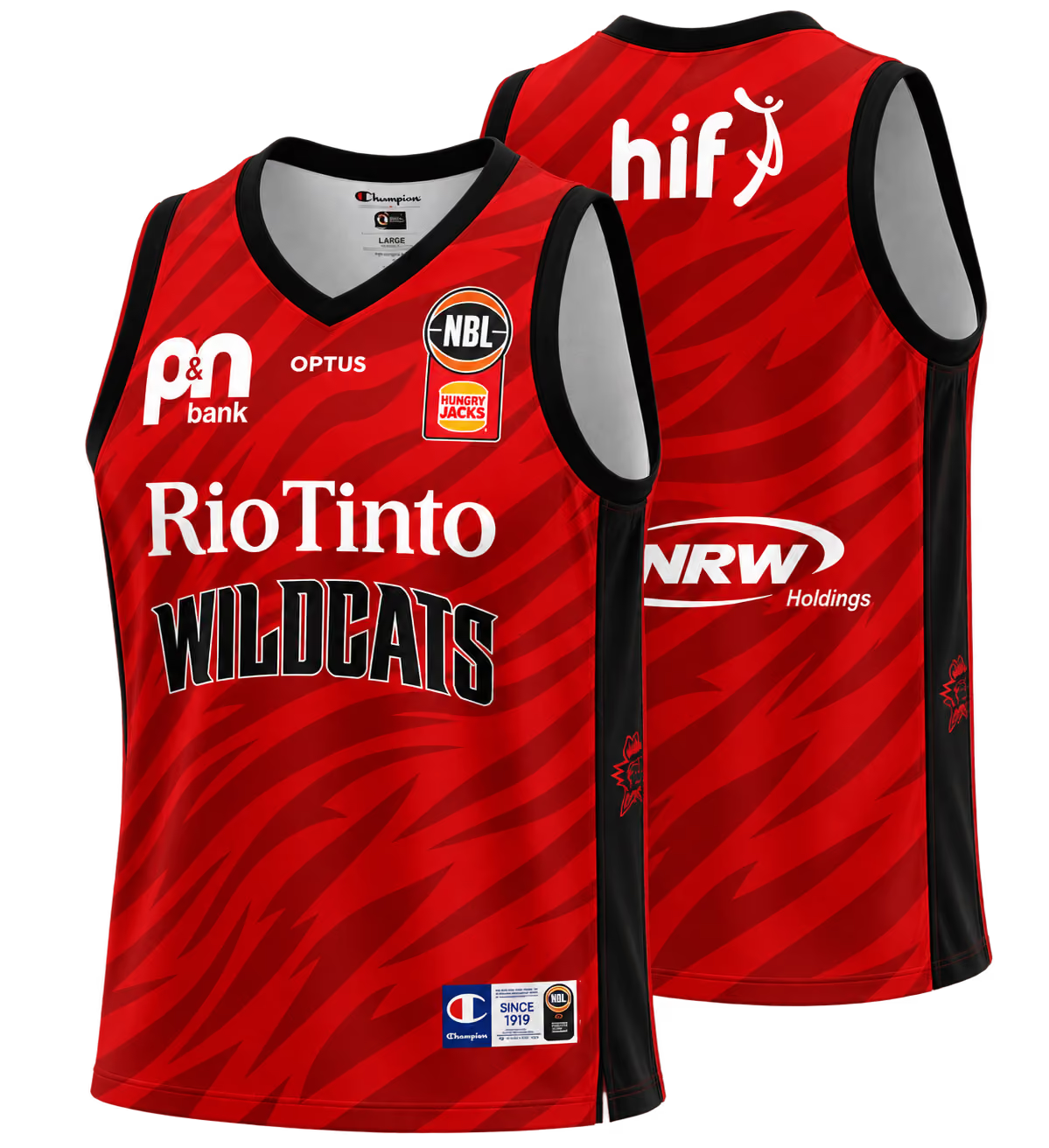
Support your team with the latest gear
Grab your latest team releases before they're gone.
Follow for behind the scenes content


Get the latest Team Updates
Breaking news & special offers. Direct to your inbox.
2026/27 Memberships Now Available
NBL Properties


Subscribe to our Newsletter


The National Basketball League acknowledges the Traditional Custodians of the lands on which we work, live & play. We pay our respects to their Elders past, present & emerging as well as all Aboriginal and Torres Strait Island Community. © year National Basketball League |Terms & Conditions | Privacy Policy